
How to Search Cases by Name
The official starting point is Georgia Courts E-Access to Court Records. Select Long County, identify Superior or State Court, and follow the provider route shown. The public provider fields were not observable without passing account or access gates, so a specific partial-name rule, required date range, or local filter should not be assumed.
- Confirm the court from a citation, pleading, notice, or other official paper.
- Open Georgia Courts E-Access and choose the listed provider for Long State or Superior Court.
- Sign in or register when required, then use the available party-name field. Try the full legal surname and given name before broader variants.
- Narrow possible matches with court, case type, filing date, and case number only when the provider actually presents those controls.
- Compare the result with the known court and case details, then contact the clerk when no reliable match appears.
| Field Label | Type | Required | Notes |
|---|---|---|---|
| Last Name | Search text | Provider-dependent | Use the legal spelling; exact and partial-match behavior was not publicly verified. |
| First Name | Search text | Provider-dependent | Use with the surname to reduce common-name results. |
| Court or Case Type | Filter | Provider-dependent | Select Long Superior or State Court only if that option appears. |
| Date Range | Date filter | Provider-dependent | Do not assume whether the filter means filed date, event date, or disposition date. |
PeachCourt Access Starts at an Account Gate
PeachCourt is the most clearly documented Long County provider route, but its logged-out screen is a login, not a public name-search form. The captured PeachCourt access screen asks for an email address and password and offers registration and password recovery.
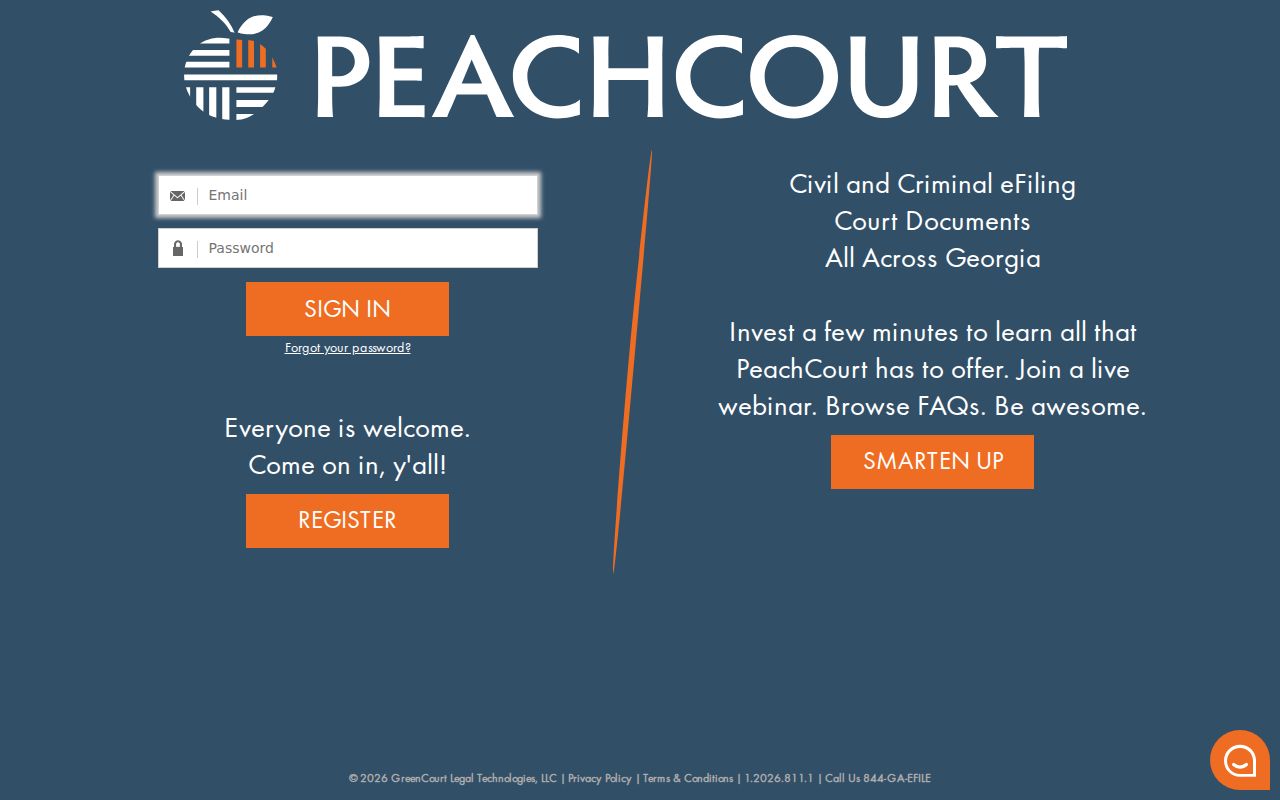
This distinction matters: a provider may support court-record access after authentication even though no case fields appear before login. PeachCourt support shown by the provider is for the vendor account, not a substitute for the Long County Clerk.
The registration screen describes a free account and collects contact, credential, security-question, PIN, reCAPTCHA, and terms-agreement fields.
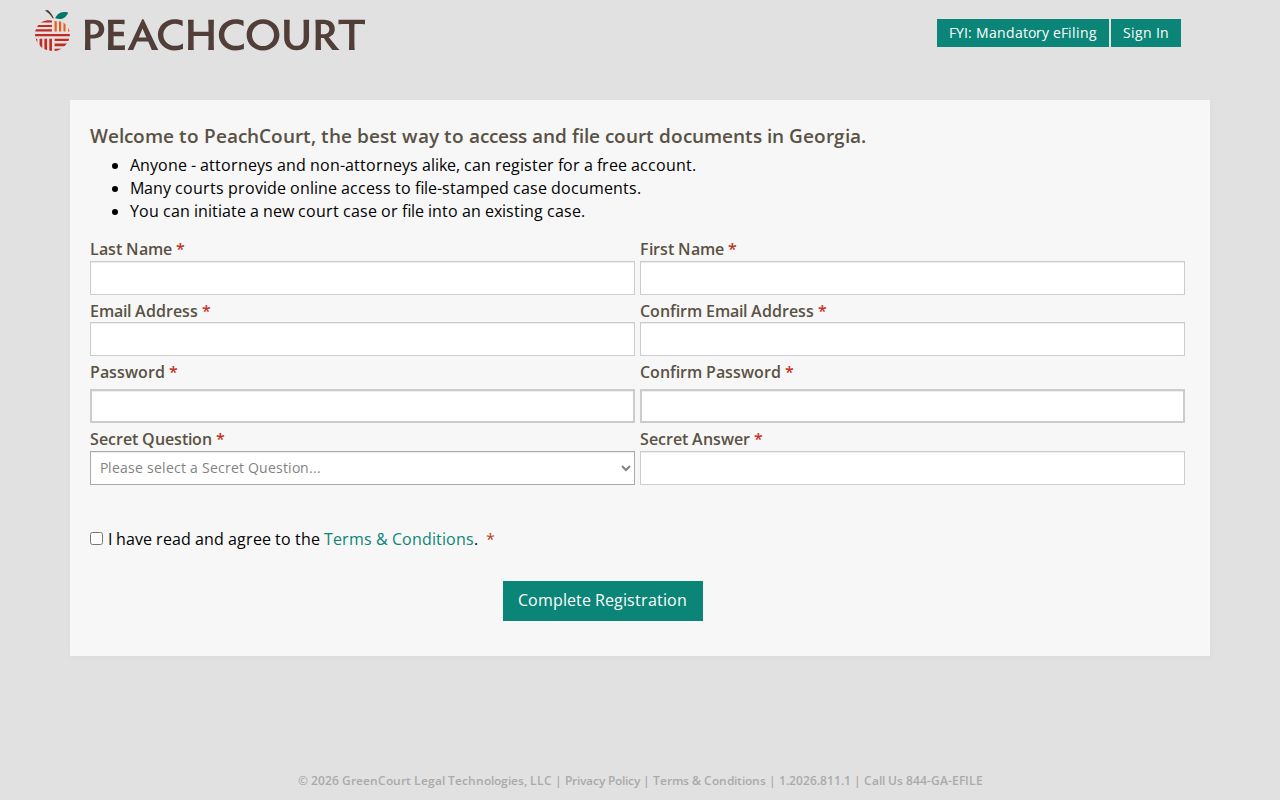
Registration may open provider functions, but document access or filing can still involve court or vendor charges. Account creation is not proof that every Long County case or image is available.
How to Search by Case Number
A case number is the strongest search key because it distinguishes cases involving similar names. Long County's official sources did not expose a verified universal numbering mask. Treat an example such as YYYY-COURT-SEQUENCE only as a reading aid, not the local format. Enter the number exactly as printed, including punctuation and leading zeros, then try a punctuation-free form only if the provider permits it.
Case numbers can differ by court and era. A State Court traffic identifier may not behave like a Superior civil number, and a citation number is not necessarily the court case number. When an old paper number fails, give the clerk the number, party name, approximate year, case type, and originating court. Do not invent case-type codes from another Georgia county.
Odyssey eFileGA Is a Filing Route, Not a Docket Promise
Georgia's e-filing infrastructure includes PeachCourt and Odyssey eFileGA. The Georgia Courts vendor chart identifies filing availability, while the public court-record route is listed separately. The captured Odyssey eFileGA dashboard remained behind a logged-out loading or account gate during research.
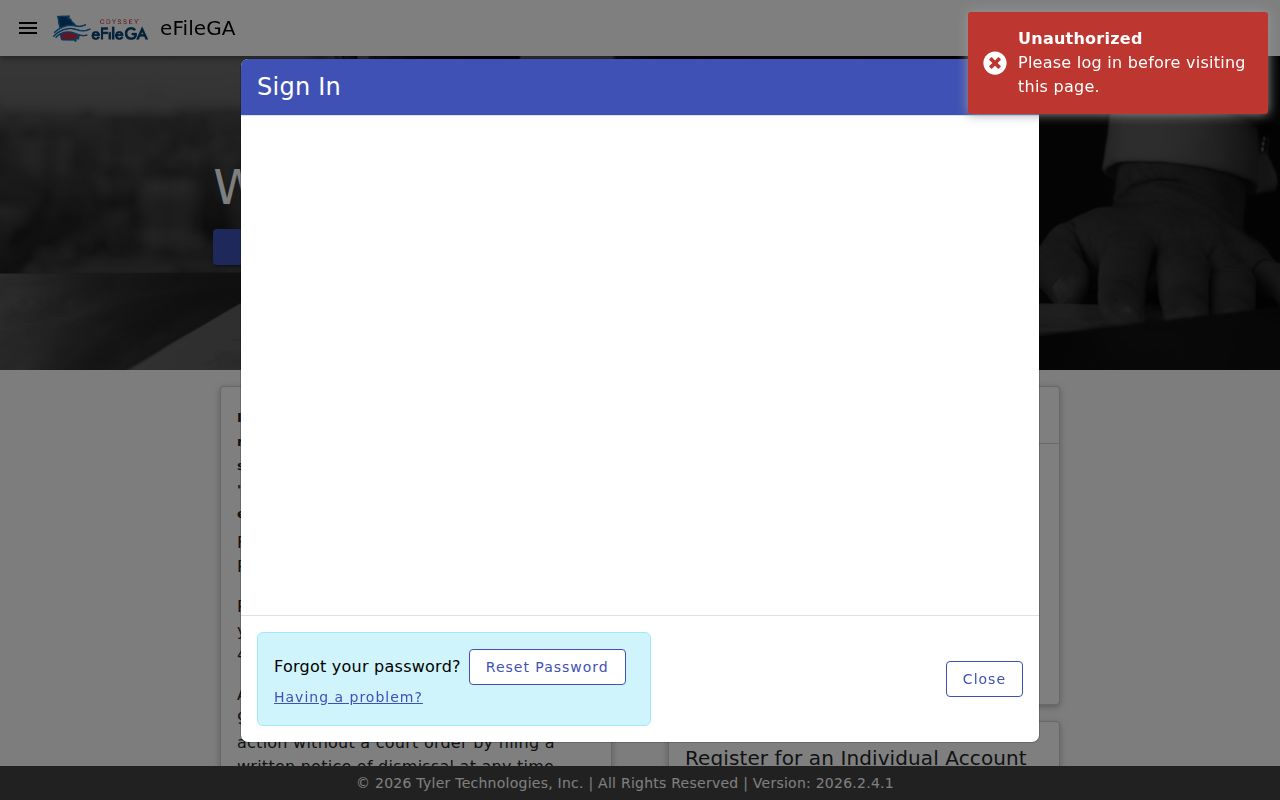
E-filing lets authorized users submit papers. It should not be described as a guaranteed public docket, complete document archive, or calendar. Search the record provider for case information and use the responsible clerk for certified or missing documents.
What a Case Search Shows
No private Long County case was opened during research, so the fields below are a preservation checklist based on docket anatomy, not a claim that every provider displays every field. Record the exact labels and values when a lawful public result is available.
| Case Number | The identifier assigned by the originating court. |
|---|---|
| Style or Parties | The caption or public party names, subject to access restrictions and redaction. |
| Court and Division | The court owning the file and any division or judge assignment shown. |
| Case Type | A category such as criminal, civil, domestic, probate, magistrate, or traffic, using the provider's wording. |
| Filed Date | The date the matter was initiated or entered, when displayed. |
| Status | A provider label such as open, pending, closed, or disposed; confirm unfamiliar local terms. |
| Docket Entries | Dated events, filings, orders, settings, service activity, or disposition entries. |
A result row or docket entry does not guarantee access to the document image behind it. Likewise, a payment confirmation is not a complete docket, and an e-certified document is a separate authenticated record product.
When the Provider Cannot Find the Case
If re:SearchGA returns an error, PeachCourt requires unavailable credentials, or an older file does not appear, preserve the exact message and contact the responsible clerk. For Superior and State Court routing, the GSCCCA directory lists Sherry McFann Long, Clerk of Superior Court, at 912-545-2123. Ask whether the file is indexed, whether inspection is available at the counter, and how to request an ordinary or certified copy.
Probate and Magistrate records follow their own offices at 75 West Academy Street. Ludowici Municipal Court handles city ordinance and municipal traffic files. Phone, in-person, and mailed requests are therefore court-specific alternatives to a provider. A county-wide Open Records form exists, but judicial-file requests should go first to the responsible court clerk because Georgia's Open Records Act route is not automatically the court-file access procedure.
County vs Statewide Case Search
Georgia Courts E-Access is a statewide directory and vendor selector, not one statewide public docket. Long Superior and State courts are listed, but local custodians still control their records. The distinction affects both coverage and depth.
| Georgia E-Access and Providers | Long County Clerk Route |
|---|---|
| Routes users among participating courts and vendors. | Handles records for the particular court within the clerk's custody. |
| May require an account, CAPTCHA, or vendor login. | Offers phone and counter confirmation; mail procedures depend on the court. |
| Useful for locating listed Superior or State Court cases. | Best for older, missing, certified, or provider-gated material. |
| Does not combine all Magistrate, Probate, Municipal, Juvenile, and traffic systems. | Can route a request to the separate court office that actually keeps the file. |
Docket Index, Document Image, and Certified Copy
These are three layers of access. The docket index is the chronological case history. A document image is the filed paper connected to an entry. A certified copy bears the clerk's authentication for formal use. Seeing an entry does not mean the image is free or downloadable, and downloading an image does not make it certified.
GSCCCA eCertification lists Long State and Superior courts as participating, but its home page uses an account and authentication-code flow. Requesters should ask about current fees before ordering because the inspected public pages did not publish a definitive Long County Superior copy schedule. For ordinary viewing, a clerk-counter inspection may be sufficient; for a formal purpose, specify the exact filing and ask whether certification is required.
Restricted Cases and Access Rules
Uniform Superior Court Rule 21 provides public access to court records while allowing sealing only under the required process and findings. Sensitive identifiers should not appear in public filings. Juvenile matters are not an ordinary public case-search category, and Georgia's Juvenile Data Exchange is an authorized environment rather than a public docket.
Sealed material, protected-person information, some guardianship or involuntary-treatment records, and confidential statutory records may be hidden or withheld. Criminal-history record restriction is also different from sealing the court file. Do not use an alternate provider to work around a restriction. Ask the clerk what public portion may be inspected and what court authorization would be needed for restricted access.