
Long County Court Calendars Explained
A court calendar identifies when a matter is set to be heard, but Long County's courts do not publish one combined calendar. The Long County Sheriff's court-information page supplies the clearest recurring local schedule: State Court is held on the second and fourth Wednesday of each month at 9:00 a.m., unless the court gives different notice. The Clerk's Office sends appearance-date notification, and the person with the case remains responsible for contacting the Clerk of State Court about the date.
Superior Court belongs to the six-county Atlantic Judicial Circuit. Its resources organize information by judges and schedules, but the inspected landing page did not expose a Long-specific daily case calendar. Magistrate, Probate, Juvenile, and Ludowici Municipal Court matters should not be inferred from the State Court pattern. The paper naming the court remains the first routing clue.
The Second-and-Fourth-Wednesday State Court Rhythm
The recurring schedule is useful for orientation, not a substitute for an individual notice. A particular case may be assigned, continued, or handled under a different direction. Determine which Wednesdays are second and fourth, then compare that general pattern with the notice sent by the Clerk's Office.
The official court-information source also separates State Court jurisdiction from Superior, Magistrate, Probate, Juvenile, and Municipal Court work. That prevents a common calendar error: assuming every Long County case follows the State Court session time. Felony and major civil matters ordinarily route to Superior Court; city citations may route to Ludowici Municipal Court.
The captured Georgia traffic appearance guidance explains why the court and instructions printed on a citation control the next step.
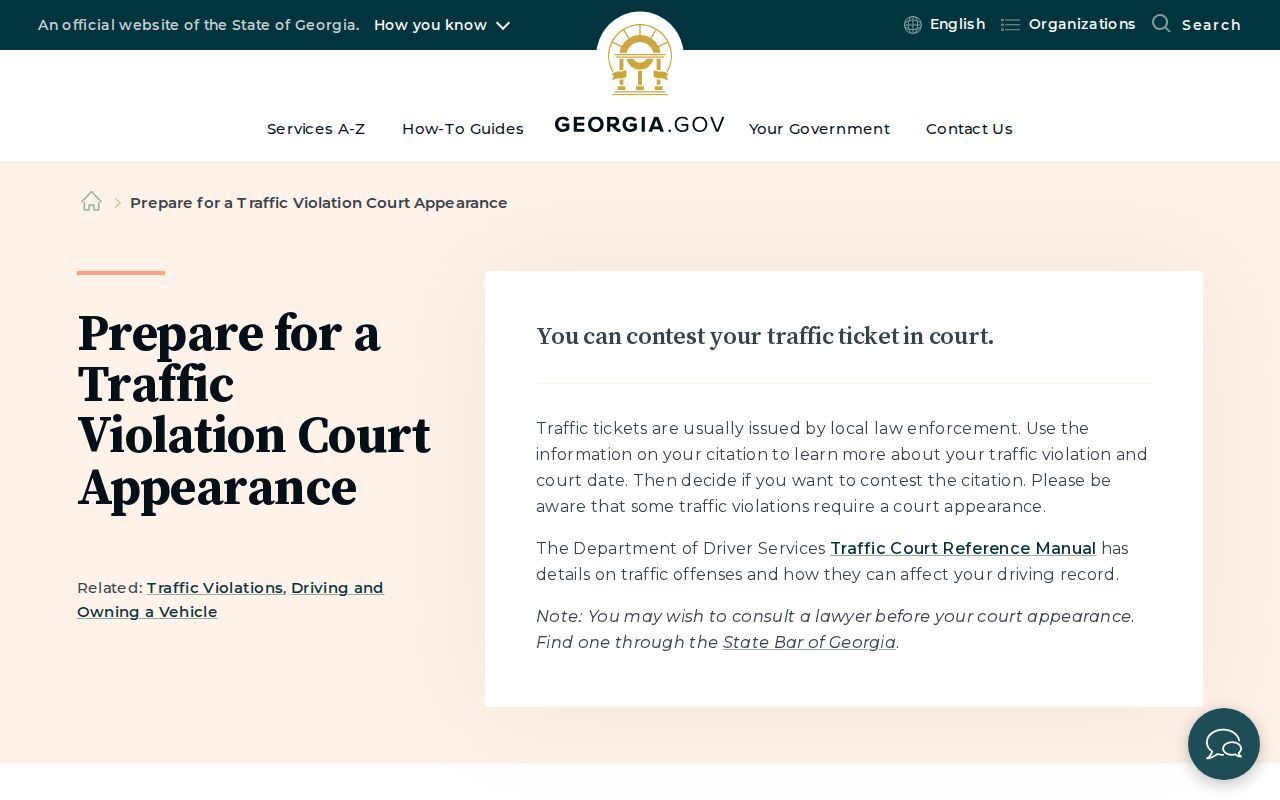
The state guidance reinforces the local rule: confirm appearance requirements with the originating court instead of treating a payment page as a calendar.
Finding Your Court Date
Begin with the case paper rather than a broad name search. A citation, subpoena, summons, bond paper, or clerk notice should identify the court and may state the controlling date and time. For Long Superior or State Court cases, Georgia Courts E-Access can route a searcher to PeachCourt or re:SearchGA, but provider access may require an account and may not display a complete real-time setting.
- Identify the court on the most recent official paper. Do not use a State Court schedule for a Superior or Municipal Court matter.
- Check that court's official source. For State or Superior Court, start with Georgia Courts E-Access; for Superior scheduling context, consult the Atlantic Judicial Circuit.
- Search with the exact case number when available, open the case record, and look for the latest hearing or setting entry.
- Compare the result with the newest mailed notice, courtroom or courthouse posting, docket call, and information from the attorney handling the case.
- Confirm the date, time, location, and setting type with the responsible clerk before travel when sources conflict or a date has moved.
For Superior and State Court routing, call the Clerk of Superior Court at 912-545-2123. Magistrate questions go to 912-545-2315, while Probate matters go to 912-545-2131. A historical Ludowici notice listed 912-545-2832 and directed people to the date and time on the citation or subpoena; verify the current municipal contact from the citation or City Hall. A party's attorney is another direct confirmation channel and may know about a signed order before a public provider reflects it.
One County, Several Calendar Keepers
Calendar ownership follows jurisdiction. The Superior Court Clerk is the practical hub for Superior, State, and Juvenile routing, although juvenile access is restricted. Probate Court maintains its own proceedings, and Magistrate Court maintains warrants, minor offenses, dispossessories, garnishments, and civil claims within its jurisdiction. Ludowici Municipal Court handles city traffic and ordinance matters. A federal matter arising from Long County does not appear on these local calendars; Long County falls in the Brunswick Division of the U.S. District Court for the Southern District of Georgia.
Quick routing check: the court name on the newest official paper outweighs a familiar courthouse name or a generic online result. If the document says Ludowici Municipal Court, use the city route. If it says Long County State Court, use the State Court and clerk route.
How to Read a Court Setting
No individual Long County calendar result was publicly captured during research, so these fields form a verification checklist, not a claimed transcription of a local screen. Read the newest entry together with the originating document and confirm blanks or conflicts with the clerk.
| Date | The scheduled appearance date on the latest notice or docket entry. Check whether a later order changed it. |
|---|---|
| Time | The appearance time, which may represent a shared docket call. State Court's recurring published time is 9:00 a.m. |
| Courtroom | The room or location where appearance is required. No current Long-specific room convention was documented, so verify it. |
| Judge | The assigned or presiding judicial officer. Atlantic Circuit scheduling may be organized by judge. |
| Setting Type | The purpose, such as arraignment, calendar call, pretrial conference, motion hearing, bench trial, jury trial, sentencing, or status conference. |
| Case Number | The court identifier used to distinguish the setting from cases involving similar names. |
| Status or Result | A later entry may show continued, reset, cancelled, heard, disposed, or another court-specific result. |
A Calendar Call Is Not Always the Trial
An arraignment addresses the charge and plea. A calendar call checks readiness and scheduling. A pretrial conference addresses issues before trial. A motion hearing resolves a specific request. A bench trial is tried to a judge, while a jury trial uses a jury. Sentencing follows a conviction or plea, and a status conference checks progress. The label matters because preparation, attendance expectations, and what may happen that day differ.
- Calendar call
- A scheduling or readiness event that may cover many cases.
- Continued or reset
- The matter is moved to another setting; it is not automatically dismissed.
- Disposed
- The court has recorded an outcome, although later filings may still occur.
Continuances, Resets, and Cancellations
A continuance or reset means the event has moved. It does not by itself mean the case was dismissed or resolved. The most reliable evidence is a later signed order, new official notice, or direct court confirmation. The State Court schedule says sessions follow the recurring pattern unless otherwise notified, leaving room for case-specific or court-wide changes.
Provider records and mailed notices may not update together. If one source still shows the old date, contact the clerk and attorney rather than choosing a date. Keep both documents. Emergency orders may affect operations, but the statewide emergency-order archive is supplemental, not a substitute for Long County confirmation.
The Long County Confirmation Chain
Use sources in an authority order. First is a signed order, current citation, subpoena, summons, or direct clerk notice. Next is the newest entry from an official court-linked provider. Then comes the official court or circuit schedule. A third-party calendar can help locate a lead but should never override the originating court.
In-person confirmation is available through the proper clerk. The GSCCCA directory lists the Superior Clerk at 458 So. McDonald Street, Ludowici, with Monday through Thursday hours of 8:00 a.m. to 5:00 p.m., Friday hours of 8:00 a.m. to 4:40 p.m., and a noon to 1:00 p.m. closure. Probate and Magistrate offices publish a separate 75 West Academy Street location and weekday hours. Official pages contain conflicting courthouse address formats, so call before relying on directions.
If You Miss a Court Setting
Act promptly. Contact the clerk for the court named on the case paper, tell the attorney, and ask what the official record now shows. Do not assume that paying online, leaving a message, or appearing on the next recurring State Court Wednesday automatically cures a missed date. The proper response depends on the court and any order entered after the absence.
Missed a Setting? A missed appearance may lead to a failure-to-appear entry, warrant, bond consequence, added cost, or driver's-license action, depending on the case.
Contact the responsible Long County clerk and your attorney immediately to learn what the court entered and whether a new setting exists.
Consult a licensed Georgia attorney before making an unannounced appearance or relying on an online payment route.
Georgia's official traffic guidance explains that paying a citation generally acts as a guilty plea and that some charges require appearance. The Georgia Department of Driver Services separately explains failure-to-appear reporting and court-release procedures. Those consequences do not turn a payment portal into a complete court calendar.