
Searching Long County Criminal Dockets
Start with the paper you already hold. Read the citation, warrant, accusation, indictment, or hearing notice. Note which court printed its name there. That court sets your route. For Long Superior or Long State Court, the official Georgia Courts E-Access list is the starting point. It lists Long State and Long Superior as separate entries. It sends users to an approved provider. An account is required, and the state page says so. Treat it as a selector, not one free statewide criminal docket.
PeachCourt is the clearest provider route on record. re:SearchGA can return an access error. An error is a cue to call the clerk. It is not a reason to trust some unverified site. These steps cover every documented route.
- Identify the court and keep the exact case, citation, or warrant number.
- Select Long State or Long Superior on Georgia E-Access and follow its provider.
- Sign in or register if the provider requires an account, then compare court and case details.
- If the case is absent, call or visit the clerk that holds that court's file.
- Ask for inspection, a plain copy, or a certified document as the need requires.
You can also work the phones. The Clerk of Superior Court answers Superior and State custody questions at 912-545-2123. For Magistrate questions, call 912-545-2315. Older files may need a trip to the counter, or you can ask about a search by mail. The Superior mailing address is P.O. Box 458, Ludowici, GA 31316. The clerk publishes no mail-copy protocol or payment rule, so call before you send money or original papers.
Long County Criminal Portal Limits
Mind the account gate on Georgia E-Access. Fields like email address and password create a login. They do not search a criminal docket. The official page makes no promise about coverage. Every old case, every document image, and every lower-court record may not show up. PeachCourt and Odyssey eFileGA are e-filing services. Filing a document and viewing a public docket are two different tasks. Even so, they sit on similar screens.
When the provider fails: preserve the court name and number, note the failed route, and contact the responsible Long County clerk. Do not infer that no case exists.
No free, anonymous Long County criminal docket screen is confirmed to exist. When one route fails, work down the chain. Try provider access first, then the newest court paper, then the clerk phone, the clerk counter, and a mailed request arranged with that clerk.
Inside a Long County Criminal Docket
The docket is the court's own timeline of a case. Line by line, it shows the judge, the case number, the filing date, and the charge. You can also spot the parties and their lawyers. Each hearing setting, every order, and the final outcome appear there as well. An appeal cross-reference appears there too if one exists. Long County publishes no official code sheet or case-number format. So treat any example number you see elsewhere with doubt. A fake pattern leads a docket search straight into a dead end.
| Header | Court, case number, judge, filing date, case type, and current status when displayed. |
|---|---|
| Charge | The alleged offense and statute description. An allegation is not a conviction. |
| Events | Filed papers, motions, orders, notices, warrant or bond events, and dated docket entries. |
| Settings | Arraignment, preliminary hearing, pretrial, trial, plea, sentencing, or another labeled event when shown. |
| Outcome | Plea, dismissal, nolle prosequi, verdict, sentence, or appeal only when the actual entry or order supports it. |
Keep in mind that a docket line is only a summary. It is not the pleading or the order itself. When you need proof of a judgment or a sentence, ask the clerk for the actual filed document and ask whether it must be certified.
Long County Criminal Court Boundaries
Here is a trap worth knowing. A warrant or a preliminary hearing entry is not a Superior Court conviction. Warrant applications, bail, preliminary matters, and minor offenses all run through Long County Magistrate Court. The serious work lives on the Superior Court docket. That means a felony prosecution from indictment through trial and sentence. State Court takes misdemeanors along with county traffic and county-ordinance cases. A citation written in Ludowici may belong to Municipal Court instead.
| Criminal matter | Likely Long County court | Contact route |
|---|---|---|
| Felony indictment, trial, sentence | Superior Court | Superior Clerk, 912-545-2123 |
| Misdemeanor or county traffic | State Court | Superior/State clerk route |
| Warrant, bail, preliminary hearing | Magistrate Court or another court as assigned | Magistrate, 912-545-2315 |
| City ordinance or city traffic | Ludowici Municipal Court | Current number on citation |
| Juvenile delinquency | Juvenile Court | Restricted-access clerk route |
Start with the originating event when you trace a Long County criminal case, then follow the later court. Keeping both numbers close at hand helps the clerk pull up any transfer or cross-reference in the docket.
How a Criminal Case Moves
A criminal docket opens differently depending on the charge and the court handling it. Some cases begin with an accusation or a citation. Others start with a warrant or an indictment. Early entries often deal with arrest process, bond, counsel, or a preliminary hearing. In Superior Court, a felony docket may then move through indictment, arraignment, motions, and status settings. It ends in a plea or trial with sentencing. Skip any stage a case never needed.
Docket flow: Filing › Arraignment › Pretrial › Plea or Trial › Disposition › Sentencing
Treat each entry on the Long County court docket as an event, not a verdict. A reset only moves a date. A motion is a request, not a ruling. A warrant simply authorizes process. No single entry establishes guilt; the exact judgment and disposition entries control the outcome.
Long County Criminal Docket Terms
Long County publishes no local abbreviation key for its court records. Software may show labels like MOT, ORD, CONT, DISP, NOS, or FTA, but treat them as unofficial shorthand rather than confirmed Long County codes. When a label puzzles you, the clerk's office can say what it means on that docket.
- Charge
- An alleged criminal violation, not a finding of guilt.
- Arraignment
- A proceeding at which charges and plea rights are addressed.
- Continuance or reset
- A move of a setting to a later date.
- Disposition
- The recorded outcome or status that resolves a charge or case.
- Nolle prosequi
- A prosecution decision not to continue a charge, subject to the actual order and docket wording.
- Certified copy
- A clerk-authenticated document, unlike a screen view or ordinary copy.
If a label could affect a deadline or a court date, do not guess. Check with the clerk and rely on the newest filed notice in the case record.
Courts That Hold Criminal Dockets
Long County criminal dockets live in more than one office. Superior Court belongs to the Atlantic Judicial Circuit. Its judges rotate across a six-county area. A circuit-wide schedule, though, tells you little about your own setting in Long County. The Clerk of Superior Court keeps the local docket. The Georgia Superior Court Clerks' Cooperative Authority lists that office as managing Superior, State, and Juvenile courts here. Start your case lookup there.
Other courts keep their own records. Magistrate filings and Ludowici Municipal cases sit with those offices. They do not sit with the Superior Court clerk. The Long State Court ticket page works for a citation lookup and payment. It is not a full criminal docket. The county legal-notice page will not replace a case search either. Whatever court you query, give the court's name before the person's name.
Long County Criminal Warrant Fallback
One number, two courts. A warrant number from Long County rarely matches the Superior Court case number that follows later. Call Long Magistrate Court first at 912-545-2315 when the warrant application or the first hearing started there. The clerk will want the warrant number and a rough year. Bring the court named on the paper, plus the kind of record you need. Felonies that move ahead get a new number. Once charges go forward, ask the Superior Clerk at 912-545-2123 whether an indictment or trial-court number exists.
The official Long Magistrate Court page lays out its process along with its rules for sensitive data. That written guidance beats any guesswork about number formats. Hold off on a county Open Records form until you know which judicial office truly holds the warrant record.
Sealed Dockets and Public Access
Court records in Long County start open. Uniform Superior Court Rule 21 presumes public inspection. Access narrows only when a statute or the rule itself limits it. Even then, a judge can shield only part of a file. That shield comes only through a defined process. A temporary restriction is not proof that the whole criminal docket is sealed forever. Often a redacted public filing stays visible even while a sensitive attachment stays protected.
Access rules: Uniform Superior Court Rule 21 governs public access and court-ordered limits. Juvenile files are a separate restricted category under Georgia law. Record restriction of criminal history is not the same as erasing every court docket entry.
Some details should never travel with a docket copy. Leave out Social Security numbers, full account numbers, complete birth dates, protected addresses, and anything identifying a juvenile. The public case history still tells you plenty without that exposed data.
Long County Criminal Process Image
The official Long County Magistrate Court process page posts the local office's own guidance for filings. It also carries its warning about personal information in court papers.
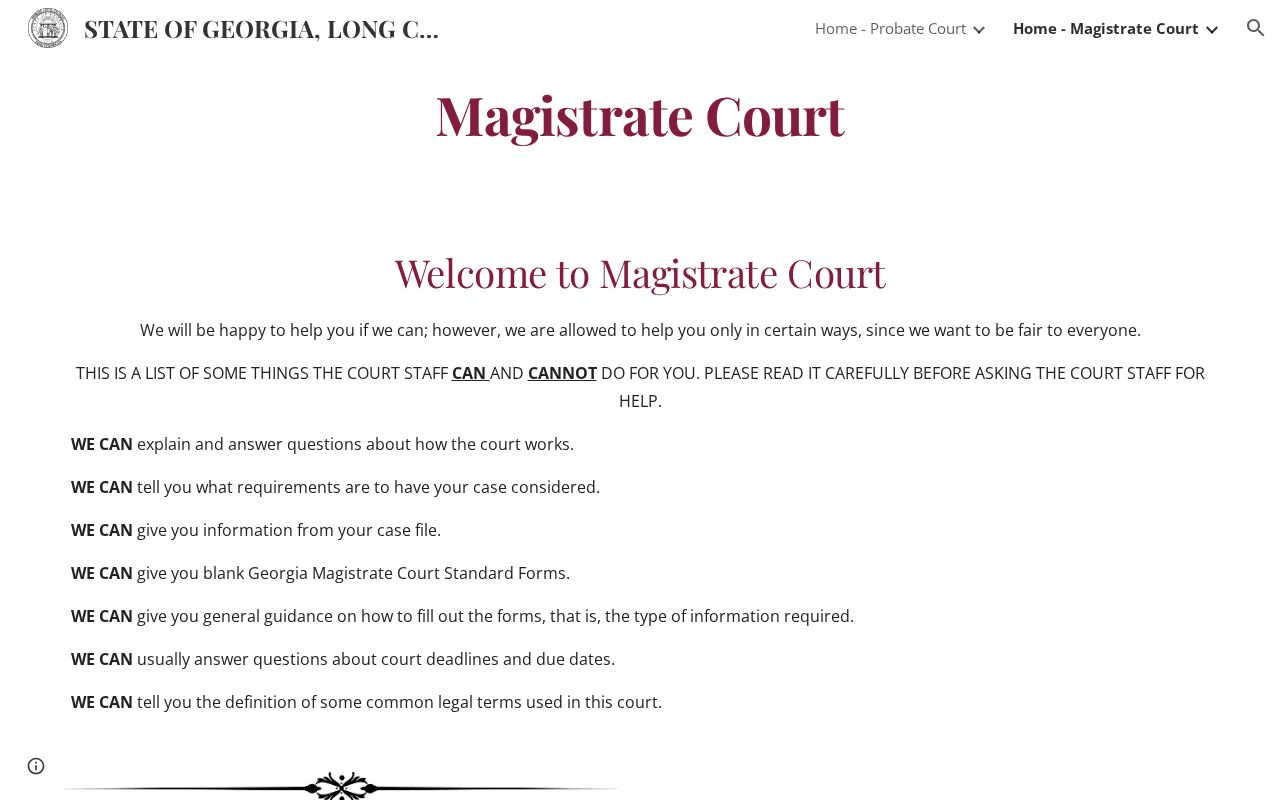
Two lessons stand out from the process page. Magistrate events run through their own clerk route, separate from Superior Court. And public filings work best when protected identifiers stay out of them.