
Searching Long County Civil Dockets
Match the claim to the court first. Superior Court alone handles divorce, equity, and title-to-land matters. State Court takes the civil actions Superior does not reserve. Magistrate Court covers money claims up to $15,000. It also handles dispossessories, garnishments, and other listed processes. Probate Court keeps estates, wills, guardianships, and related files. For Long Superior or State, begin at Georgia Courts E-Access. Pick the court before typing a party name, since Long State and Long Superior sit on separate rows. You may need an account with the provider. Probate offers no public search database. The official Magistrate civil e-filing link points to an older portal worth confirming before you rely on it.
- Identify the court from the complaint, summons, order, or case number.
- Use E-Access for Long Superior or State and follow the listed provider.
- Compare the court, caption, filing date, and case type before opening a result.
- Use the separate Magistrate or Probate office route when that court holds the matter.
- Ask the clerk for inspection, a plain copy, or a certified document when needed.
The clerk counter works without a screen. Phone and mail are the other documented routes. Superior and State questions go to 912-545-2123, Magistrate to 912-545-2315, and Probate to 912-545-2131. Mail reaches Superior at P.O. Box 458; Probate and Magistrate use P.O. Box 426, Ludowici, GA 31316. The Superior clerk publishes no mail-copy instructions, so confirm the exact document, fee, and payment method before sending anything.
Long County Civil Jurisdiction Split
The dollar amount settles less than people assume. Magistrate's cap routes many small money claims there. Yet Superior Court keeps exclusive control of divorce, equity, and land-title disputes regardless of the sum. Outside those exclusive areas, State Court holds broad civil authority. Probate is a separate system entirely, not just another row in the general civil provider.
| Long County civil matter | Likely court | Practical distinction |
|---|---|---|
| Divorce, equity, title to land | Superior Court | Superior-exclusive subjects |
| Other civil actions | State or Superior Court | Subject matter and filing rules control |
| Money claim up to $15,000 | Magistrate Court | No jury trial in Magistrate |
| Dispossessory or garnishment | Magistrate Court | Short response rules may apply |
| Estate, will, guardianship | Probate Court | Separate clerk and fee list |
Pick the court before trusting a name query. A search run in the wrong court looks complete while the case sits somewhere else in plain view.
Inside a Long County Civil Docket
Think of the civil docket as an event log. It records the case identity, public party roles, filing dates, service events, motions, orders, hearings, judgment, costs, satisfaction, and appeal links. The papers themselves sit behind that history. A complaint, affidavit, exhibit, proof of service, or judgment is a document, and a short docket entry cannot reveal everything written inside it.
| Case header | Court, case number, case type, filing date, judge, and status when displayed. |
|---|---|
| Caption | Public plaintiff and defendant, or petitioner and respondent, labels. |
| Service | Issue, attempt, return, waiver, or other service event shown by the clerk. |
| Filings | Complaint or petition, answer, motion, affidavit, exhibit, and later paper entries. |
| Settings | Hearing, status, motion, pretrial, or trial dates as labeled in the actual record. |
| Outcome | Dismissal, default, judgment, satisfaction, transfer, or appeal when documented. |
Long County publishes no official grammar for its civil case numbers. Never build a docket search around an invented prefix. Ask the clerk to verify an unfamiliar format.
Long County Magistrate Claim Route
Long Magistrate Court shares more process detail than most. Staff can explain filing steps, hand out standard forms, and pull case-file information. They cannot give legal advice. They cannot predict an outcome, change an order, or speak to the judge for a party. A statement of claim tops out at $15,000 in money relief. Service starts the clock. A post office box is not a service address. Most small civil answers are due within 30 days. Default can follow after 45 days in most cases, subject to the file and the applicable rules. Magistrate Court holds no jury trials. A written jury request can remove the matter to a court that does.
If a claim was just served: read the summons, verify the filed service event, and contact the Magistrate clerk promptly. Do not calculate a deadline from a portal snippet alone.
Civil Case Types on the Docket
Each court's limits shape what its docket holds. Broad labels overlap, so the relief requested and the court named on the paper matter more than any generic category.
- Contract, debt, damage, and other money claims.
- Divorce, equity, and title-to-land cases in Superior Court.
- Dispossessory, garnishment, and personal-property foreclosure in Magistrate Court.
- Other civil actions within State Court jurisdiction.
- Estate, will, administration, and guardianship matters in Probate Court.
Some records carry extra locks. Family, juvenile, guardianship, and involuntary-treatment files can face added access limits. A public event line on the docket does not guarantee every linked document is open.
Long County Civil Filing Timeline
Filing and service start civil time, not an online result. A dispossessory answer is generally due within seven days, per the Long Magistrate page. Small civil parties get 30 days. Every later paper must reach the other side. The filing carries a certificate of service. That certificate is a statement that service of that paper occurred.
Typical docket flow: Filing › Service › Answer › Motions › Hearing or Trial › Judgment › Satisfaction or Appeal
Not every case follows that line. A default can arise when no timely answer lands. A transfer may move the matter to State or Superior Court, while garnishments and dispossessories run on their own process. Read the latest order rather than assuming the next event from a generic sequence.
Civil Docket Settings and Hearings
A civil setting should name the court, date, time, and purpose when the source displays those fields. Long County posts no public daily civil calendar. A provider entry, the newest filed order, a summons, or a clerk notice beats any general schedule. Confirm uncertain settings with the clerk. Magistrate date changes work differently. Ask in advance, in writing, and serve the other side with the request. A reset is a new date. Keep the request, certificate, and signed order. The broader Long County court dates resource helps tell a recurring session from a case-specific notice.
Long County Civil Fees Compared
Long Magistrate publishes its civil fee amounts openly. Superior Court plain-copy and certification costs for Long County do not appear in any posted schedule. So ask the clerk for those before you file. Payment at Magistrate runs to cash, money order, MasterCard, or Visa. Cards may carry a convenience fee, and personal checks are not accepted.
| Magistrate filing or service | Published amount |
|---|---|
| Statement of claim, one service included | $105 |
| Dispossessory affidavit, one service included | $80 |
| Personal-property foreclosure, one service included | $105 |
| Garnishment | $105 |
| Sheriff service or re-service | $50 |
| Transfer case | $22 |
Probate keeps a separate fee schedule for its own services. A certified copy there costs $10, miscellaneous customer copies run $1, and those figures cover Probate work rather than every Long County civil record.
Civil Docket Access Rules
Access to a Long County civil docket starts from openness. Georgia Uniform Superior Court Rule 21 presumes public inspection unless a statute or a proper access-limitation order says otherwise. Uniform Magistrate Rule 20 takes a different angle. It shields sensitive identifiers in filings. So parties should generally include just the last four digits of any Social Security, tax, or account number, along with the birth year alone, unless an exception or a court order allows more detail.
Public does not mean unredacted: a docket entry can remain visible while a sensitive page, protected identifier, or restricted document is withheld. Uniform Magistrate Court Rule 20 addresses sensitive data in filings.
Long County's administrative Open Records form leans on the Georgia Open Records Act, O.C.G.A. § 50-18-70 et seq. The form can get you inspection or copies. It covers county-held administrative records. A judicial certified copy is another matter, though. Name the court and the right office before you file anything. For a court file, go straight to the responsible clerk rather than relying on a broad county request.
Long County Civil Office Images
The official Long Magistrate fee page lays out the local filing and service fees that apply to small civil matters.
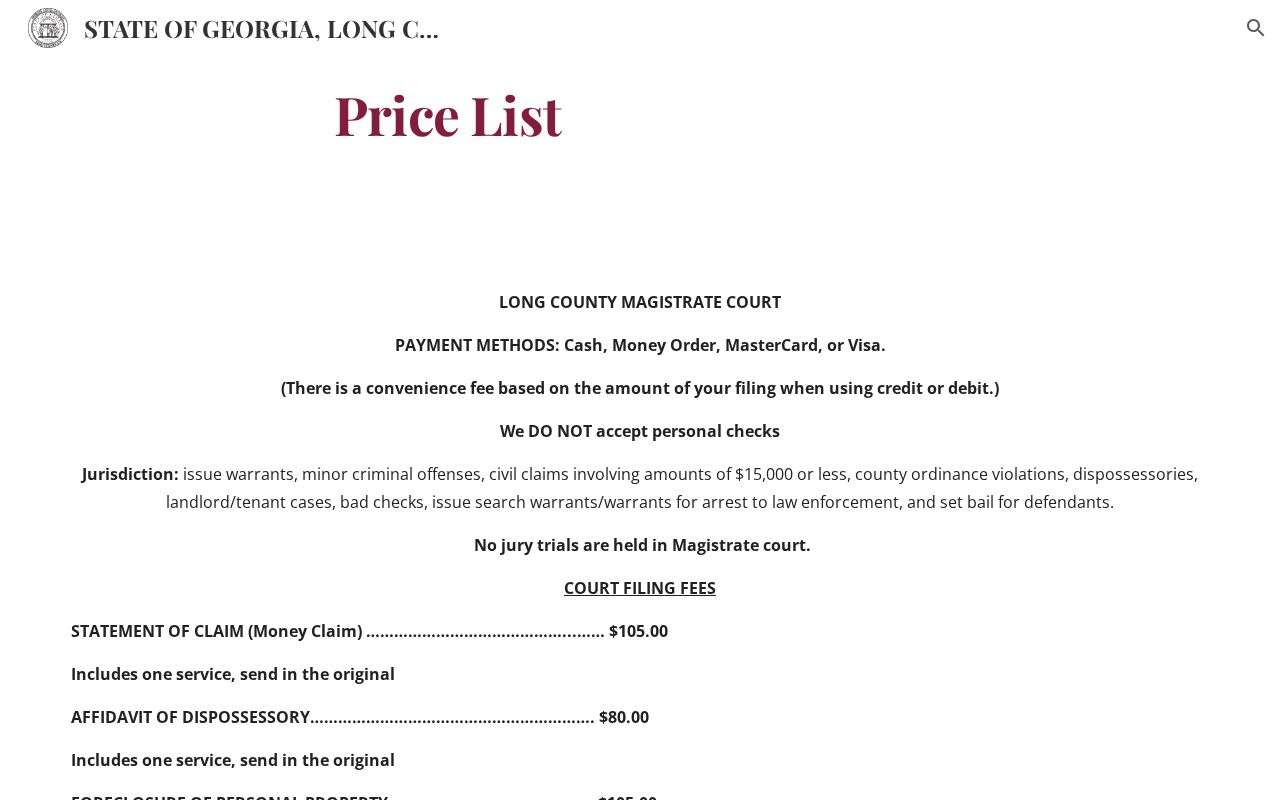
For the current total with any added service, a quote from the clerk still beats anything online. The official page confirms the local amounts listed here.
Probate filings run on their own fee route. The Long County Probate Court price list shows that separate track clearly.
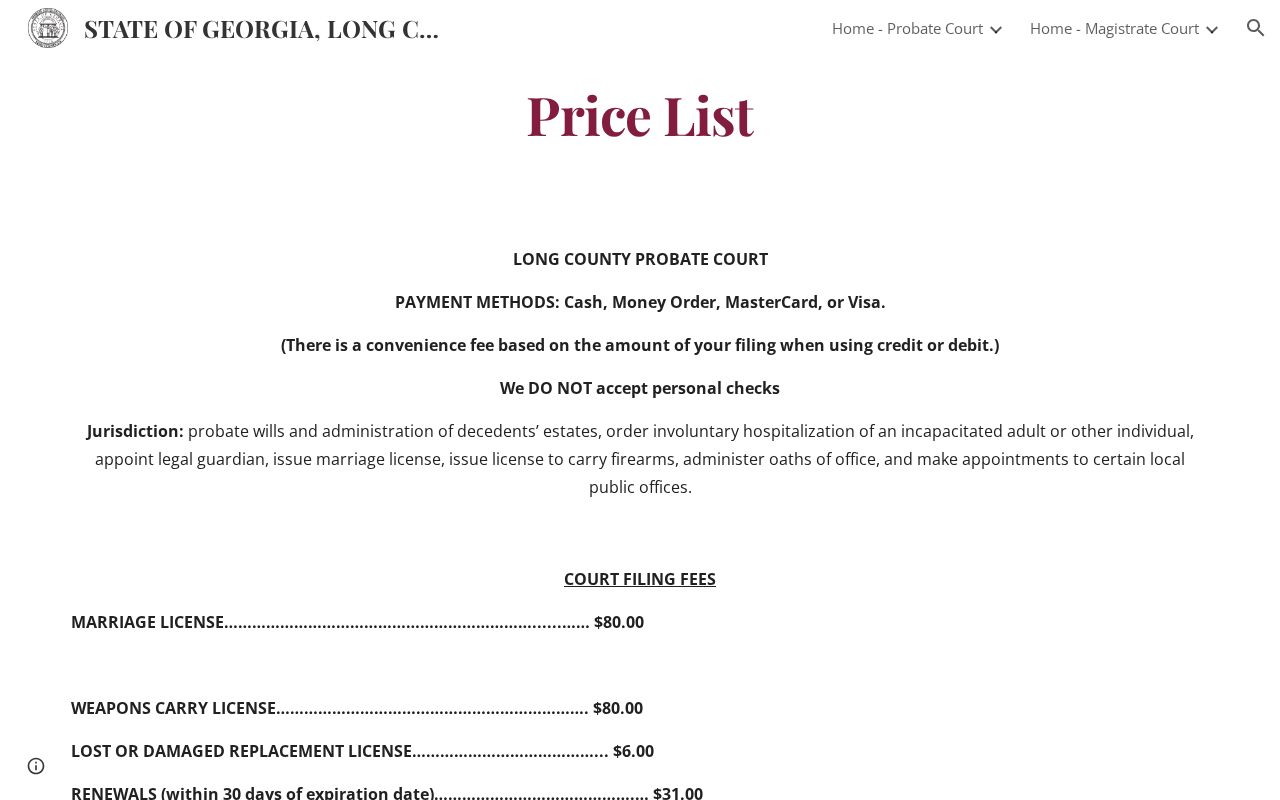
The probate fee sheet covers its own filings and copies only. Treat it as distinct from the civil fee schedules used by the Superior, State, or Magistrate court.